
AI vs Traditional Keyword Research: What Actually Works in 2026
Dive Into Our Podcast
Traditional Keyword Research: What It Still Does Better Than Any AI
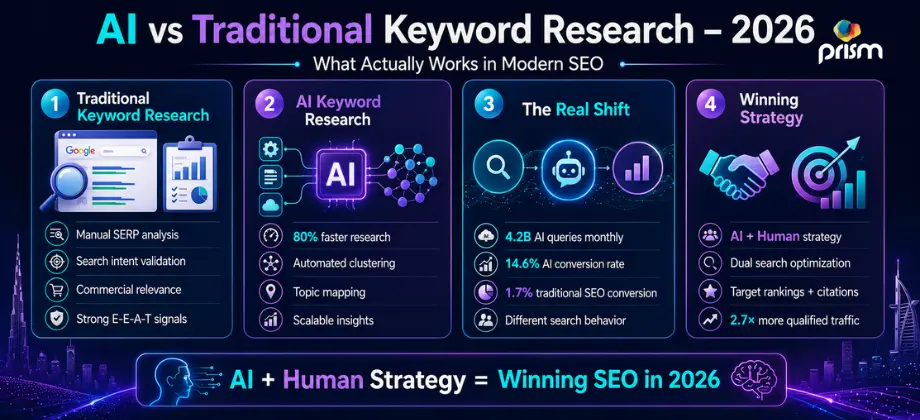
Traditional keyword research — running manual searches, interpreting SERPs page by page, cross-referencing intent, validating commercial value against real business context — is slow. It is also something AI still cannot fully replicate, and here is why that matters.
Human researchers understand nuance that machine learning models approximate. When a B2B SaaS company says they want to rank for “cloud storage,” a skilled researcher recognises that the top 10 results are dominated by consumer brands, that the commercial intent is misaligned, and that “enterprise file management UAE” is a longer path to a better customer. No keyword tool, AI or otherwise, makes that call automatically.
Traditional SEO content servicesalso carry something AI-generated research cannot manufacture: genuine E-E-A-T signals. Google’s Helpful Content system and the March 2025 Core Update made this explicit. Content optimised purely for search engines without the backing of real expertise is being deprioritised at scale. That takes human judgment to build, and human judgment starts with human keyword strategy.
What AI Does to Keyword Research That Changes the Game
Now the honest counterpoint: AI-powered keyword research tools compress a week of manual clustering into minutes. Brands using AI for topic clustering are seeing up to 70% faster research cycles,and AI-powered platforms reduce keyword research time by 80% overall.
But the more consequential shift is this: how AI search differs from traditional search [sk] at a fundamental level. Traditional keyword tools surface what people are typing into Google today. AI search optimization is the process of aligning topics to the conversational prompts that people are asking on ChatGPT, Perplexity, and Gemini tomorrow. These aren't the same lists.
Only 14% of URLs cited by Google’s AI Mode rank in the traditional top 10.And 28.3% of ChatGPT’s most cited pages have zero organic visibility in traditional SERPs.If your keyword research only targets the traditional results page, you are invisible to a growing share of high-intent searchers who will never click a blue link at all.
“AI search actually depends on traditional SEO to work. LLMs don’t invent information out of thin air — they pull from indexed web content, authority signals, and trusted sources. Without solid SEO foundations, brands disappear from AI answers entirely.” — PBJ Marketing, AI SEO vs Traditional SEO (January 2026)
The Comparison That Actually Matters
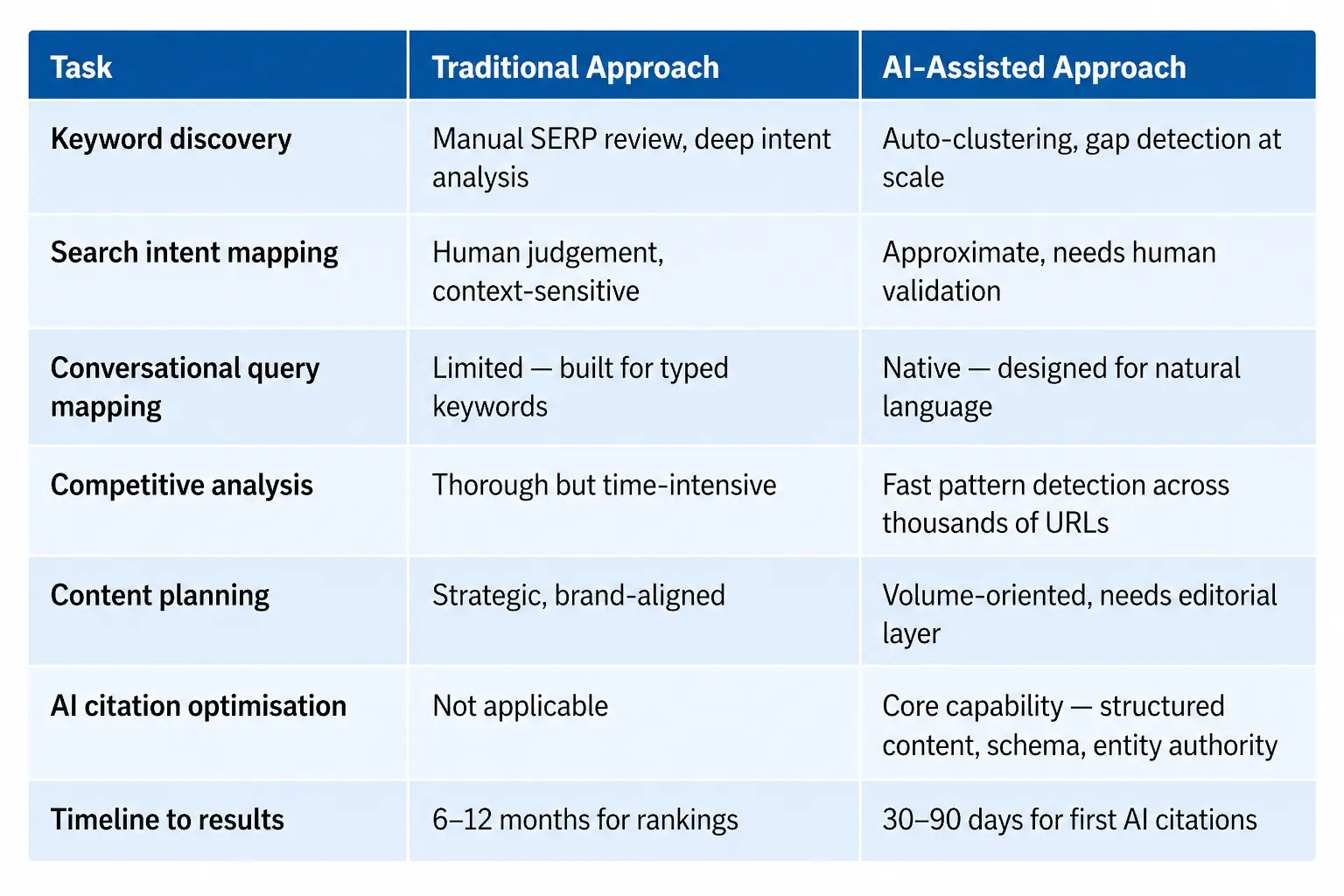
Rather than debating AI SEO vs traditional SEO as a binary choice, the better frame is: which tasks belong to which approach?
The Real Problems People Are Running Into
Most professionals in 2026 even continue to struggle with the usual suspects:
AI keyword tools surface volume, not value
AI tools excel at identifying what people search for. They are significantly less reliable at identifying which of those queries will convert for a specific business in a specific market. Feeding AI output directly into content briefs without commercial intent validation is one of the fastest ways to produce high-volume, zero-revenue content.
Teams optimise for traditional rankings and ignore AI visibility — or vice versa
The data from compare traditional and AI search results rankingsresearch is consistent: neither channel is optional in 2026. Companies optimising for both see 2.7× more qualified traffic than single-channel strategies.Choosing a lane is not a strategy. It is a market share concession.
AI-generated content without E-E-A-T gets filtered, not rewarded
Google’s content quality systems are filtering AI-generated content that lacks depth, real experience, or original analysis. The practical conclusion to draw is that large-scale generation of keyword-stuffed content using AI is not going to be a competitive advantage for 2026. It’s a risk of penalty.
What the Winning Approach Actually Looks Like
The strongest ai-assisted seo vs traditional seo optimizationstrategies in 2026 combine both layers with explicit role assignments. The practical framework is presented as follows.
• The team will use AI tools to achieve faster results at larger scales because they need to process keyword clustering and competitor gap analysis and content brief generation and topic mapping work which exceeds human capacity.
• The team will use human expertise to guide their work on validating commercial intent and determining brand positioning and audience details and selecting which keywords need to be targeted.
• Every asset must be developed for dual search engine optimization because all content needs to be designed for conventional search engine result pages while being structured for use in AI-created content. These two processes operate as one because they need the same technical components which include schema markup and answer-first content structure and E-E-A-T signals and entity authority.
• The team should measure the appropriate metrics for each search engine result. Traditional SEO: rankings and clicks and organic sessions. AI SEO: citation frequency, AI referral traffic, share of model. Standard tools (Semrush, Ahrefs) measure the first. Purpose-built AI monitoring tools measure the second. Both matter.
The Bottom Line
The differences between AI search optimization and traditional SEO tools are real, but the businesses treating them as competing priorities are building towards a narrowing market. AI search is not replacing traditional search. It is adding a second surface that operates on different rules, rewards different content structures, and increasingly captures high-intent buyers before they ever reach a traditional results page.
If your keyword research still starts and ends with a spreadsheet of search volumes, you are optimising for a version of search that is smaller than it was last year. The teams pulling ahead are running Keyword Research Services in Dubaithat simultaneously target traditional rankings and AI visibility — not as two separate strategies, but as one integrated framework. Whether you need a full strategic overhaul or a sharp SEO Agency in Dubaiaudit of where your current keyword strategy is leaving an opportunity on the table, the starting point is understanding which search surface your target customers are actually using. And in 2026, they are using both. Your On-Page SEO Servicesshould reflect that.

About The Author: Lovetto Nazareth
Lovetto Nazareth is the Founder & CEO of Prism Digital, a Dubai-based digital marketing and advertising agency he started nearly two decades ago from a laptop and a vision, as he puts it, to one of the region's established full-service agencies spanning SEO, PPC, social media, web design, and PR.
Over more than 19 years in advertising and digital marketing, Lovetto has guided thousands of campaigns across the UAE and GCC, working across sectors from real estate to hospitality to fintech. He writes and speaks on digital transformation and marketing strategy, and has contributed opinion pieces to Campaign Middle East, one of the region's leading marketing trade publications.
He takes a data-first approach to growth testing, measuring, and iterating rather than relying on guesswork and outside of work he's an adventure sports enthusiast and a singer-songwriter.