
Does AI Content Work for Search Engines? What Google Actually Rewards in 2026
Dive Into Our Podcast
Is AI Content Killing or Saving SEO?
The AI-generated content has created the largest controversy in current search marketing practices. Critics assert that AI-generated material destroys SEO because it produces numerous low-value standard articles which flood the internet. The first group believes that AI-generated material achieves superior search engine results because AI content produces greater volume which delivers better performance through data-based improvements.
What is the actual situation?
The introduction of AI Overviews and generative answers together with new ranking systems creates a crucial decision point for content creators and marketers and publishers as Google transforms into an AI-powered search engine. The main question which needs investigation is whether AI produced content for search engine optimization purposes proves effective in practice.
This matters more than ever in a post-cookie, post-AI-overview world where traffic is shrinking, competition is intensifying, and trust is becoming the ultimate ranking factor. In this guide, we break down real data, Google’s official stance, insights from SEO professionals on Reddit, and actionable best practices to reveal when AI content succeeds — and when it fails spectacularly.
What Is AI Content & How It’s Being Used Today
An AI content generator uses large language models (LLMs) to produce written material based on prompts, keywords, and training data. An AI SEO content generator creates content by combining three essential components which include keyword research and SERP analysis and SEO optimization capabilities. The term generative AI for content creation describes tools that can generate various content types including blogs and product pages and scripts and social media captions and additional content formats.
Today, marketers use AI for:
- Blog writing
- Product descriptions
- Landing pages
- SEO topic clusters
- Programmatic SEO at scale
According to DailyAI and ClickRank research, over 70% of digital marketers now rely on AI-assisted content workflows. CopyDetect reports that publishers use AI to accelerate research, drafting, and optimization — but still require human editorial layers for performance and quality control.
In practice, AI is no longer a novelty. It’s embedded into content production pipelines across SaaS companies, publishers, agencies, and ecommerce brands. However, the way it is used — not simply the fact that it is used — determines success.
Can AI Content Rank on Google? What Research Shows
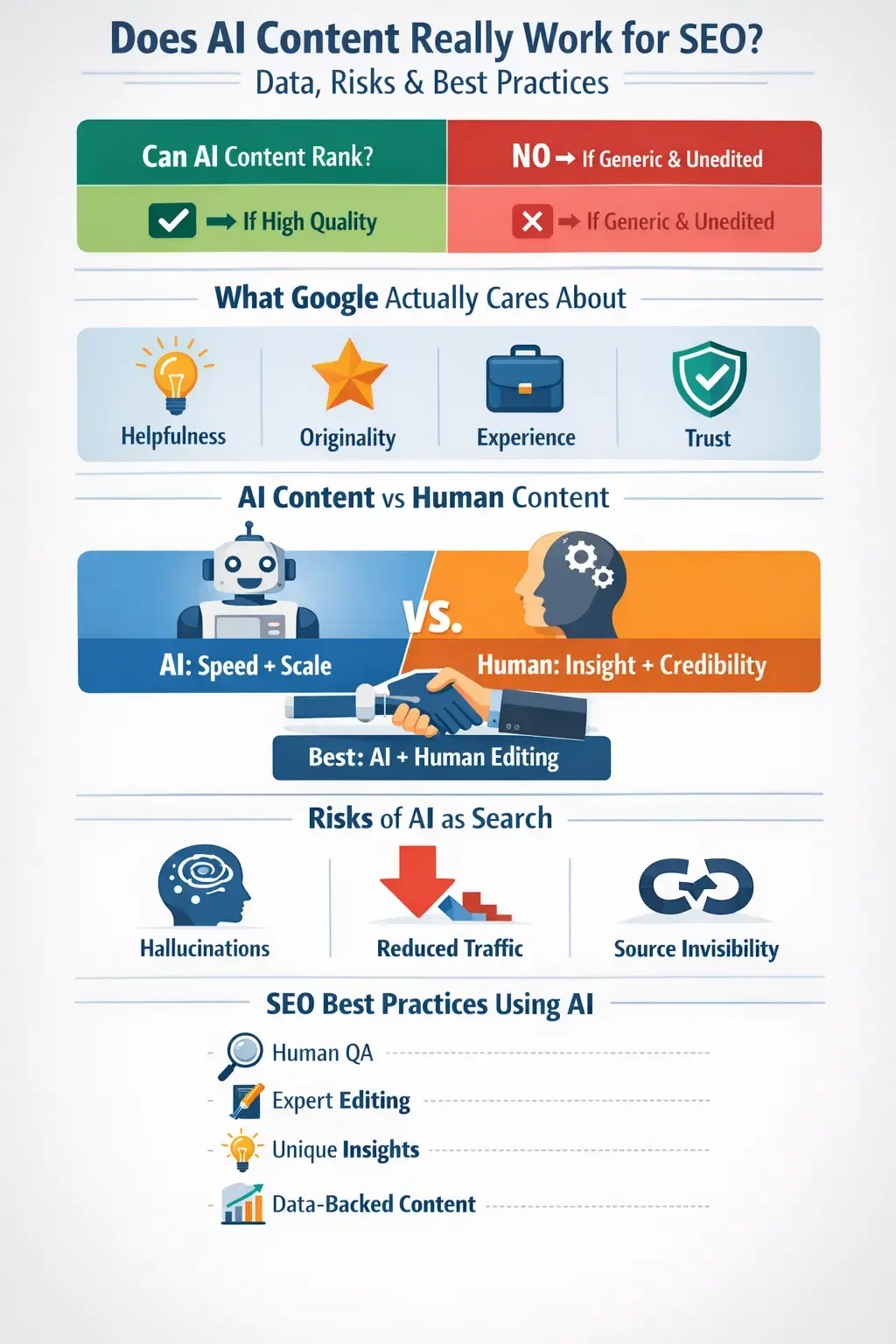
Short answer: Yes — but only when quality and human oversight are involved.
Multiple studies from DailyAI, ClickRank, CopyDetect, Media Search Group, and WP Suites show that AI generated content for SEO can rank, but performance depends heavily on editorial quality.
Key research findings:
ClickRank observed that AI-assisted content edited by humans achieved 32–45% higher organic traffic growth than purely manual workflows.
The Media Search Group discovered that AI-generated drafts created better indexing results than their human-assistants.
CopyDetect determined that entirely unmodified AI-generated content performed poorly because it displayed minimal content and lacked credible expertise and received weak user interaction.
Why does AI + human editing perform best?
AI excels at:
- Speed
- Scale
- Pattern recognition
- Structural consistency
Humans excel at:
- Experience-based insight
- Strategic storytelling
- Contextual nuance
- Credibility and trust
Unedited AI content fails because it often produces:
- Generic phrasing
- Surface-level analysis
- Repetitive structures
- Outdated or inaccurate facts
In short: AI can rank — but only when it’s treated as a writing assistant, not a replacement for human intelligence.
Google’s Official Position on AI Content
Google has made its position clear through multiple statements which declare that the company does not punish websites for featuring content that was created by artificial intelligence. The company assesses content according to its three primary criteria which include content quality and content usefulness and content trustworthiness.
According to Google Search Central and SocialPress analysis, Google’s ranking systems rely heavily on:
- E-E-A-T principles (Experience, Expertise, Authoritativeness, Trustworthiness)
- The Helpful Content System
- Spam detection algorithms
Google explicitly states that automation is not against policy, but low-quality, unhelpful, mass-produced content is.
In practice, this means:
- AI-written content is allowed
- Spammy, thin, or misleading AI content is penalized
If your AI-generated content:
- Adds original insight
- Demonstrates expertise
- Solves user problems
- Offers real value
It can rank.
If it merely rewrites existing articles with no differentiation, it will struggle — regardless of whether a human or AI wrote it.
Reddit & SEO Community Reality Check
SEO professionals on Reddit provide a brutally honest view of how AI content performs in real-world environments.
Across multiple threads consistent patterns emerge:
What works:
- AI-assisted outlines
- AI for first drafts
- Human editing
- Expert review
- Real examples and case studies
What fails:
- Bulk-published AI blogs
- Programmatic pages with no editorial oversight
- Auto-generated listicles
- Mass AI scaling with zero QA
One senior SEO manager summarized it best:
“AI is a brilliant intern. But you still need a strategist, editor, and subject expert.”
Another noted:
“Our rankings tanked when we let AI publish raw. They rebounded once we layered human editing.”
The takeaway is clear: AI works when guided by human strategy. Unedited automation consistently fails.
Why Using AI as a Search Engine Can Be Dangerous
While AI-generated content can support SEO, AI-powered search introduces new risks.
As tools like Google AI Overviews, ChatGPT, and Perplexity become mainstream, several concerns emerge:
1. Hallucinations & Fabricated Facts
AI models can generate plausible-sounding but false information. Research from arXiv shows hallucination rates between 3%–27%, depending on topic complexity.
2. Reduced Publisher Traffic
The Guardian reports that AI summaries dramatically reduce clicks, cutting publisher traffic by 30–60% in some verticals.
3. Source Invisibility
AI often summarizes content without clearly attributing sources, eroding brand authority and citation equity.
4. High Environmental & Computing Costs
Large-scale AI inference consumes massive energy, raising sustainability concerns highlighted in arXiv studies.
5. Transparency Issues
Users increasingly struggle to distinguish between verified facts and probabilistic AI outputs.
For SEO ecosystems, AI-powered search threatens:
- Organic visibility
- Traffic attribution
- Publisher monetization
This forces brands and publishers to protect organic authority, build brand recognition, and strengthen content trust signals.
Best Practices: How to Use AI for SEO Without Getting Penalized
This is where most strategies succeed — or fail.
Effective AI writing and search engine optimization depends on structured human workflows.
Editorial Workflow Used by Top SEO Marketing Services
- Keyword & intent mapping
- AI-assisted outlines & drafts
- Human subject-matter editing
- Original insights & examples added
- Data integration & citations
- Editorial QA review
- Technical SEO optimization
Practical AI SEO Checklist
Content Quality
- Does it answer the search intent?
- Does it add new insights?
- Is it fact-checked?
Human Experience
- Does it include real examples?
- Does it reflect firsthand expertise?
- Is it written for humans, not algorithms?
SEO Optimization
- Logical heading structure
- Semantic keyword inclusion
- Internal linking
- Natural anchor text usage (e.g., SEO Marketing Services)
Trust & Credibility
- Clear authorship
- Source citations
- Updated statistics
Avoid:
- Mass publishing
- Duplicate structures
- Template-driven outputs
- Thin articles
The best-performing teams treat AI as a content accelerator, not a content factory.
Key Takeaways: AI Is a Tool — Not a Strategy
AI-generated content for SEO can rank — and often does. But it can also fail spectacularly when misused.
Search engines do not reward automation. They reward:
- Value
- Experience
- Trust
- Usefulness
The winning formula in 2026 is AI + human expertise + editorial rigor.
AI accelerates research, drafting, and optimization — but humans provide insight, judgment, creativity, and credibility.
The future of AI generated content for SEO does not belong to those who publish the most. It belongs to those who publish the most useful, trustworthy, and human-centered content. The best way to start your content journey is to work with an experienced SEO agency in Dubaiand use the team’s expertise to rank on the top in no time!

About The Author: Lovetto Nazareth
Lovetto Nazareth is the Founder & CEO of Prism Digital, a Dubai-based digital marketing and advertising agency he started nearly two decades ago from a laptop and a vision, as he puts it, to one of the region's established full-service agencies spanning SEO, PPC, social media, web design, and PR.
Over more than 19 years in advertising and digital marketing, Lovetto has guided thousands of campaigns across the UAE and GCC, working across sectors from real estate to hospitality to fintech. He writes and speaks on digital transformation and marketing strategy, and has contributed opinion pieces to Campaign Middle East, one of the region's leading marketing trade publications.
He takes a data-first approach to growth testing, measuring, and iterating rather than relying on guesswork and outside of work he's an adventure sports enthusiast and a singer-songwriter.