

Is Your Brand Visible in AI Search? A Practical AI Search Audit Framework for 2026
Dive Into Our Podcast
The Rise of AI Search: Why This Changes Everything
Traditional SEO optimized for:
10 blue links.
AI search optimizes for:
1 summarized answer.
Systems like:
- ChatGPT
- Google AI Overviews
- Perplexity
- Claude
- Gemini
don’t just list links. They synthesize.
They compress the web into a single response.
And increasingly, users never click through.
This changes the visibility equation entirely. It’s no longer about ranking position. It’s about AI citation probability — the likelihood that your brand is referenced inside a generated answer.
Most marketers are still obsessing over keyword positions while AI systems are rewriting the rules.
The traffic model we built our SEO strategies on for 15 years is being restructured in real time.
Why Brands Are Invisible in AI Search
Here’s what I consistently see during AI visibility audits:
Brands that dominate traditional SERPs often disappear inside AI answers.
Why?
1. AI Prioritizes Trusted Third-Party Sources
AI systems frequently cite:
- Wikipedia
- Authoritative publishers
- Review platforms
- Industry roundups
Earned media often outranks brand-owned websites in AI summaries.
You may control your site.
You don’t control how the broader web describes you.
2. Extractability > Keyword Density
AI systems don’t “rank pages.”
They extract structured meaning.
Semantic clarity now matters more than keyword stuffing ever did.
Definitions.
Clear comparisons.
Structured explanations.
Entity descriptions.
I’ve seen brands with perfect on-page SEO fail simply because their content wasn’t extractable.
3. Entity Signals Matter More Than Pages
AI doesn’t just read content.
It models entities.
If your brand isn’t consistently defined across:
- Knowledge panels
- Structured data
- Third-party mentions
- Author bios
- Schema markup
You’re harder for AI to confidently cite.
Stop thinking in keywords.
Start thinking in entities.
What Is Generative Engine Optimization (GEO)?
Generative Engine Optimization (GEO) is the practice of optimizing content so AI systems cite your brand when generating answers. It builds on SEO — but it shifts the objective.
Traditional SEO Generative Engine Optimization
- Traditional SEO
- Generative Engine Optimization
- Ranking position
- Citation probability
- Click-through rate
- Inclusion in AI summaries
- Keyword targeting
- Entity clarity
- SERP share
- AI share of voice
- GEO isn’t replacing SEO.
- SEO builds authority.
- GEO converts authority into AI citations.
- Strong backlink profiles and domain trust still matter. In fact, research and early audits suggest that high-authority domains are more frequently surfaced in AI systems.
- But authority alone isn’t enough.
- Authority must be structured for extraction.
The AI Search Visibility Audit Framework (2026 Edition)
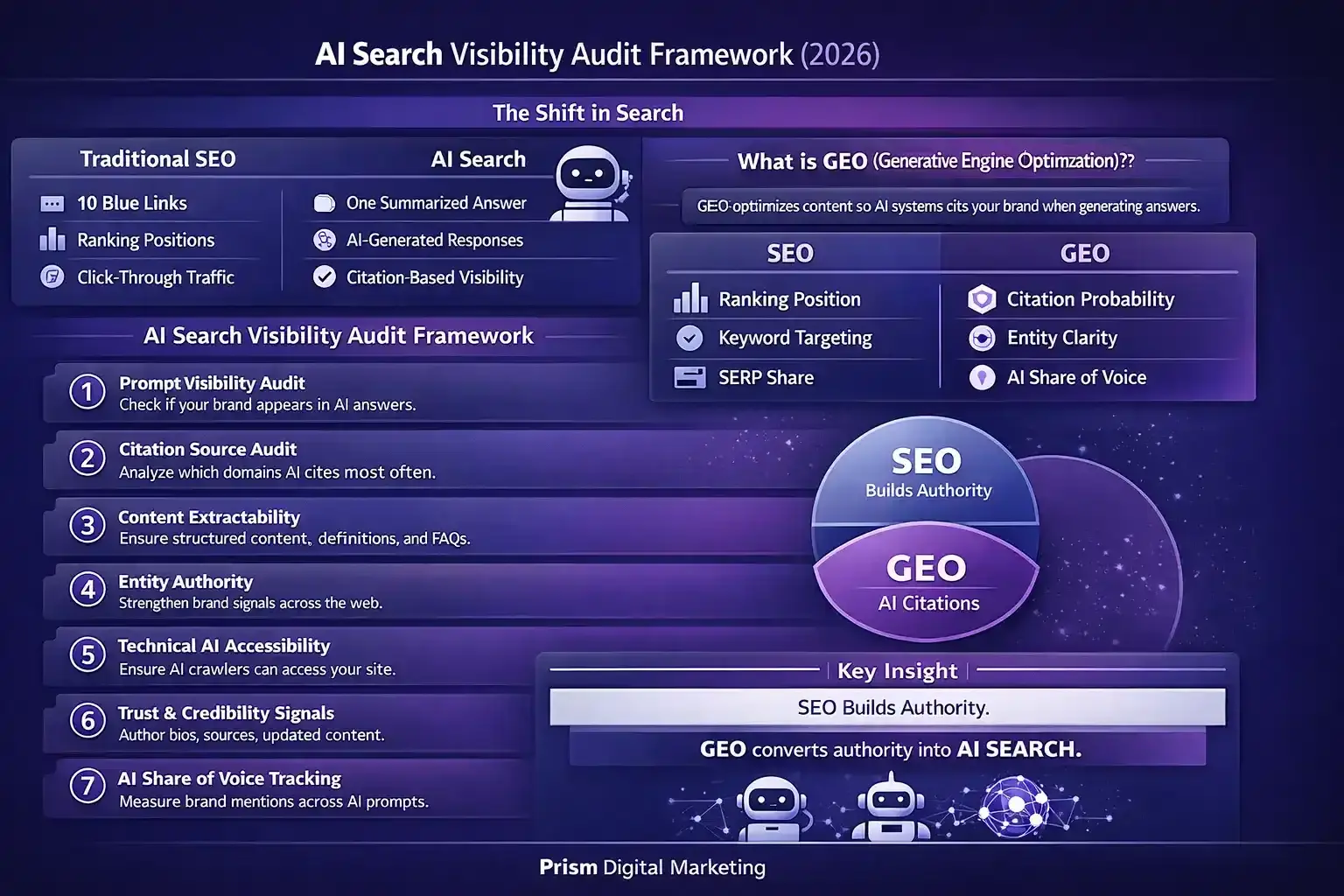
Here’s the practical framework I use when auditing brands for AI visibility.
This is your AI search audit framework.
1️Prompt Visibility Audit
Start with real user prompts.
Examples:
- Best digital marketing agencies in Dubai
- Alternatives to HubSpot CRM
- Best CRM tools for ecommerce
Run these across:
- ChatGPT
- Perplexity
- Claude
- Google AI Overviews
Then analyze:
- Does your brand appear?
- Is it cited or just mentioned?
- Which competitors dominate?
- Which domains are referenced?
This reveals your real AI search visibility, not your theoretical ranking strength.
Many brands are shocked by this step.
Citation Source Audit
Next, analyze which domains AI prefers.
You’ll often find:
- Editorial sites dominate
- Aggregators outperform brands
- Wikipedia is heavily cited
- Review sites gain disproportionate visibility
AI doesn’t just rank websites.
It chooses sources it trusts.
If competitors are consistently cited from high-authority publications while your presence is mostly self-published content, your citation probability drops.
This is where digital PR becomes part of GEO.
3️.Content Extractability Audit
Now evaluate your content itself.
Ask:
- Is your brand clearly defined in the first 200 words?
- Do you include structured definitions?
- Are there comparison tables?
- Do you provide quotable sentences?
- Are FAQs included?
AI prefers:
✔ Clear definitions
✔ Bullet points
✔ Comparison tables
✔ Structured formatting
✔ Semantic headings
Walls of marketing copy rarely survive extraction.
I often tell clients:
If your page reads like a brochure, AI will skip it.
4️Entity Authority Audit
AI systems build internal representations of brands as entities.
Audit:
- Knowledge Graph presence
- Consistent brand naming
- Organization schema markup
- Author schema
- Third-party mentions
- Executive profiles
- Wikidata entries
Inconsistent naming across platforms weakens entity clarity.
AI models reward coherence.
This is the shift most agencies aren’t talking about.
SEO optimized pages.
GEO optimizes entity ecosystems.
5️Technical AI Accessibility Audit
This step is often ignored.
Verify:
- robots.txt does not block AI crawlers
- GPTBot access is allowed (if strategically appropriate)
- Proper schema markup exists
- Pages render fully (no heavy JS blocking content)
- Semantic HTML structure is clean
You cannot be cited if you cannot be crawled.
Technical accessibility directly impacts AI citation probability.
6️Trust & Credibility Audit
AI models tend to avoid content that appears:
- Overly promotional
- Anonymous
- Undated
- Poorly sourced
- Lacking author authority
Audit:
- Are authors named?
- Are credentials visible?
- Are sources cited?
- Are publication dates updated?
- Is tone informational rather than sales-heavy?
In my audits, content with strong expertise signals consistently performs better in AI-generated summaries.
AI systems are risk-averse.
They prefer citing stable, authoritative content.
7️Share of Voice in AI Answers
Traditional SEO tracks:
- Rankings
- Backlinks
- SERP positions
But AI search demands new metrics.
Track:
- % of prompts where your brand appears
- Competitor citation frequency
- Sentiment of mentions
- Position within generated summaries
- Source domains cited
This creates an AI visibility scorecard.
Instead of “we rank #3,” the new benchmark becomes:
“We appear in 42% of high-intent AI prompts.”
That’s a strategic KPI.
Tools for Tracking AI Visibility
Traditional SEO tools like:
- Semrush
- Ahrefs
- Moz
Track rankings and backlinks well.
But they weren’t built for AI citation analysis.
Emerging tools include:
- Otterly AI
- AuditGeo
- AI search tracking platforms
These attempt to measure:
- AI citation frequency
- Prompt coverage
- Brand mention consistency
The tooling ecosystem is still early.
But ignoring AI measurement entirely is riskier.
Critical Insight: SEO Still Matters — But It’s Not Enough
One of the biggest misconceptions I see is panic.
“Is SEO dead?”
No.
Strong SEO foundations still influence AI discovery.
Backlinks, authority, and structured content correlate strongly with AI visibility.
But here’s the nuance:
SEO builds authority.
GEO converts authority into citations.
Without SEO, you lack trust.
Without GEO, you lack inclusion.
You now need both.
Final Thought: The Next Layer of Visibility
AI search is not experimental anymore.
It is actively shaping how information is consumed.
Users are asking:
- “What’s the best CRM for ecommerce?”
- “Top marketing agencies in Dubai.”
- “Is this software reliable?”
And they’re accepting AI summaries as final answers.
If your brand isn’t cited by AI systems, you’re not just losing traffic.
You’re losing relevance in the next layer of the internet.
The question is no longer:
“Where do we rank?”
It’s:
“Are we visible when AI decides what matters?”

About The Author: Lovetto Nazareth
Lovetto Nazareth is the Founder & CEO of Prism Digital, a Dubai-based digital marketing and advertising agency he started nearly two decades ago from a laptop and a vision, as he puts it, to one of the region's established full-service agencies spanning SEO, PPC, social media, web design, and PR.
Over more than 19 years in advertising and digital marketing, Lovetto has guided thousands of campaigns across the UAE and GCC, working across sectors from real estate to hospitality to fintech. He writes and speaks on digital transformation and marketing strategy, and has contributed opinion pieces to Campaign Middle East, one of the region's leading marketing trade publications.
He takes a data-first approach to growth testing, measuring, and iterating rather than relying on guesswork and outside of work he's an adventure sports enthusiast and a singer-songwriter.