
Meta Ads Andromeda Update: Why Meta Ads Are Now a Creative Game, Not a Targeting Game
Dive Into Our Podcast
What the Meta Ads Andromeda Update Actually Is?
So what exactly is the meta andromeda update?
At its core, Andromeda is a new AI-powered ad retrieval and ranking system developed by Meta. It uses deep neural networks to evaluate millions of potential ad-user combinations in real time.
It evaluates numerous possible ad-user pairs through its deep neural network technology which operates during live testing. The system predicts which advertising content will most effectively connect with individual users at particular times instead of matching ads to preexisting audience segments. The algorithm conducts its analysis through simultaneous evaluation of multiple factors which it handles as distinct variables, such as:
- user behavior patterns
- historical engagement signals
- ad creative elements
- contextual browsing activity
The goal is to determine which ad is most relevant to each individual user, even when the advertiser hasn’t defined a highly specific audience.
This represents one of the biggest architectural shifts in meta andromeda update advertising systems.
Meta is no longer just optimizing targeting.
It’s optimizing message relevance.
Why Meta Is Moving Away From Audience Targeting?
For most of the past decade, Meta Ads strategies revolved around audience segmentation.
Advertisers built campaigns using:
- interest targeting
- demographic filters
- lookalike audiences
- retargeting pools
This approach worked well when Meta’s data ecosystem allowed precise audience identification.
But several major changes pushed the platform toward a different model.
Privacy updates and iOS tracking restrictions which resulted in signal loss together with new data access rules made it impossible to achieve accurate audience targeting.
Meta achieved substantial advancements in its artificial intelligence capabilities during this period.
The algorithm now shifts its primary focus from advertiser-defined audiences to analyzing behavioral signals together with user engagement patterns.
The system assesses user content interactions to determine which ad creative will receive the highest user engagement or conversion rate.
The algorithm now shifts its main focus away from user identification to studying user behavior.
The present moment shows that campaigns which target broad audiences achieve better results than campaigns which target specific audience segments.
The Real Shift: Creative Targeting Instead of Audience Targeting
The biggest implication of the meta andromeda ads update news is that creative strategy has become the primary optimization lever.
Instead of asking:
“Which audience should see this ad?”
Marketers must now ask:
“Which message will resonate with different user mindsets?”
The algorithm analyzes creative elements such as:
- visual style
- messaging tone
- storytelling format
- past engagement data
Then it decides which ad version to show to each user.
From my perspective, this represents the rise of creative-first targeting.
The algorithm effectively tests different narratives and messages across audiences, learning which ones perform best.
Many advertisers say their old targeting strategies stopped working overnight—not because Meta broke advertising, but because the system started optimizing differently.
If you’re still obsessing over interest targeting, you’re probably playing yesterday’s game.
Why Many Meta Campaigns “Stopped Working”?
Since the rollout of the meta andromeda update, many advertisers have struggled to maintain performance.
But the issue is rarely the algorithm itself.
Instead, campaigns often fail because they were designed for an older advertising model.
Common problems include:
Overly segmented audiences
Highly granular targeting limits the algorithm’s ability to explore different optimization paths.
Too few creative variations
When advertisers only test one or two ad creatives, the algorithm has limited material to learn from.
Overly complex campaign structures
Multiple ad sets and micro-targeted audiences create unnecessary fragmentation.
Outdated testing strategies
Small design tweaks rarely produce meaningful performance differences.
Insufficient conversion signals
The algorithm needs clear conversion data to learn effectively.
In many ways, the Andromeda update has exposed weaknesses in campaign strategy that were previously hidden by manual targeting.
In my opinion, the update essentially killed the era of lazy optimization.
Advertisers can no longer rely on audience tricks alone.
The New Campaign Strategy That Works After Andromeda
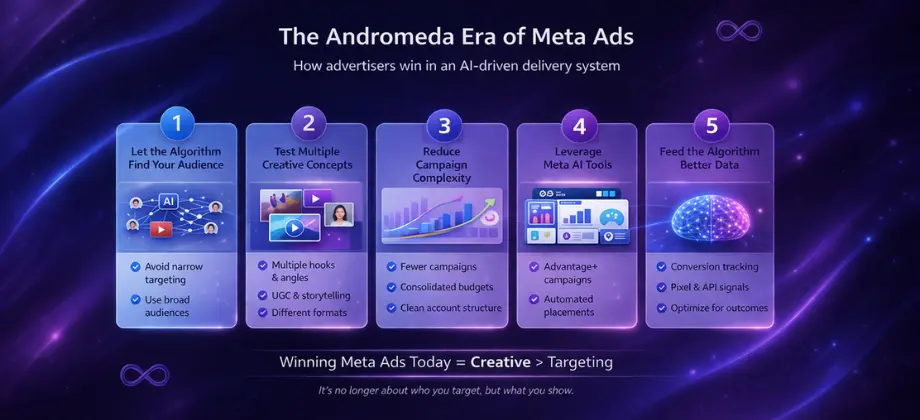
Successful campaigns in the Andromeda era often follow a simpler structure.
Instead of dozens of micro-targeted ad sets, many advertisers now use:
- fewer campaigns
- broader audiences
- larger budgets per campaign
- more creative variations
This approach allows the algorithm to collect stronger signals and identify which creatives resonate with different segments of users.
From my experience, broad targeting combined with diverse creative testing often produces more stable performance than complex targeting structures.
The algorithm is extremely good at finding patterns—but only when it has enough data to work with.
Creative Strategy for the Andromeda Era
If creative is now the primary optimization lever, the obvious question becomes:
What kind of creative strategy works best?
One important lesson from recent campaigns is that creative diversity matters more than design tweaks.
Instead of testing multiple versions of the same ad, advertisers should test different creative concepts entirely.
Examples include:
- emotional storytelling
- educational or informative content
- promotional messaging
- problem–solution narratives
- customer testimonials
Each of these approaches speaks to a different user mindset.
The algorithm can then match the right narrative to the right audience.
In my experience, campaigns with four to six distinct creative concepts often outperform campaigns that rely on small variations of the same idea.
Why Advantage+ Campaigns Matter More Now
Another important piece of the Andromeda ecosystem is Meta Advantage+ automation.
These tools integrate closely with the new AI-driven advertising infrastructure.
Advantage+ campaigns automate several optimization tasks, including:
- audience expansion
- budget allocation
- placement optimization
- creative enhancements
Many advertisers initially resisted these automated features because they reduced manual control.
But as Meta’s AI systems improve, automated campaigns often outperform heavily optimized manual structures.
The system can analyze thousands of signals simultaneously—something no human campaign manager can realistically replicate.
For agencies providing social media marketing, this shift means strategy is becoming more creative-focused and less technically focused.
Campaign success increasingly depends on storytelling, messaging variety, and creative experimentation.
Conclusion
The meta ads andromeda update signals a fundamental transformation in digital advertising.
For years, success on Meta depended largely on precise audience targeting.
The automated features decreased advertising control which advertisers used to control their campaigns. The automated campaigns now achieve better results than the manually optimized systems because Meta's AI systems continue to develop. The system can analyze thousands of signals simultaneously—something no human campaign manager can realistically replicate. The agencies that deliver social media marketing services now need to develop creative strategies that replace their previous technical strategies. Campaign success increasingly depends on storytelling, messaging variety, and creative experimentation.
Because the brands that succeed will not be the ones with the most complicated targeting setups.
They will be the ones telling the most compelling stories.

About The Author: Lovetto Nazareth
Lovetto Nazareth is the Founder & CEO of Prism Digital, a Dubai-based digital marketing and advertising agency he started nearly two decades ago from a laptop and a vision, as he puts it, to one of the region's established full-service agencies spanning SEO, PPC, social media, web design, and PR.
Over more than 19 years in advertising and digital marketing, Lovetto has guided thousands of campaigns across the UAE and GCC, working across sectors from real estate to hospitality to fintech. He writes and speaks on digital transformation and marketing strategy, and has contributed opinion pieces to Campaign Middle East, one of the region's leading marketing trade publications.
He takes a data-first approach to growth testing, measuring, and iterating rather than relying on guesswork and outside of work he's an adventure sports enthusiast and a singer-songwriter.