
GA4 + AI for Performance Marketing: Strategies Used by Top UAE Marketing Agencies
Dive Into Our Podcast
What is Predictive Intelligence?
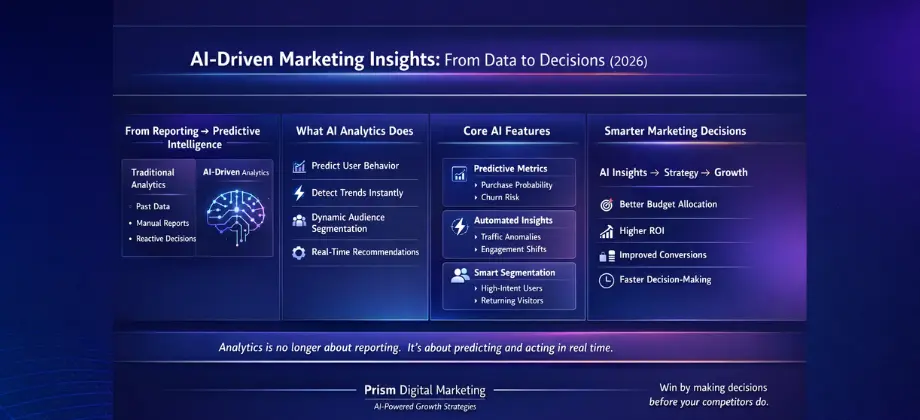
Conventional analytics tools were built to address questions about the past.
Marketers used them to answer:
• What happened on the website last week?
• Which campaign brought in the most traffic?
• Which pages receive the most traffics?
These insights were useful, though they were naturally backward-looking. The marketers analyzed the data after the campaign was already over.
Today's analytics platforms, in contrast, are around predictive intelligence.
Rather than just telling you how well you have done in the past, they aim to answer questions such as:
• Which users are most likely to convert?
• Which customers are liable to run away?
• What marketing channels will generate the most revenue?”
It’s part of that ongoing shift toward the primacy of AI-driven marketing insights.
Analytics is no longer about just measuring results — it’s about predicting results and providing guidance for decision-making in real-time.
A great deal of marketers (and b2b marketers in specific) still don’t get just how big this shift is.
Why GA4 Is an AI-Powered Marketing Analytics Platform
Aside from Google Analytics 4 (GA4) being one small part of this shift, it is also one of the biggest examples.
Unlike earlier editions of Google Analytics, GA4 was designed around machine learning and predictive modeling. The platform uses an analysis of patterns of behavior between users, and automatically produces insights that previously required complex manual analyses.
A handful of AI-driven features illustrate this evolution.
Predictive Metrics
GA4 includes predictive metrics that estimate future user behavior.
These include:
- purchase probability
- churn probability
- predicted revenue
These figures allow marketers to find the audiences that are most valuable. "For users that belong to a segment with a high probability of making a purchase, marketers can reach them with conversion-centric campaigns or even personalized deals or offers. "Predictive Targeting of This Nature Used to Require Enterprise-Level Analytics This type of predictive targeting was once the purview of complicated enterprise analytics systems.
Today it’s built directly into GA4.
Automated Insights
One more incredible feature is the automated insights.
GA4 is constantly monitoring traffic trends and can detect anomalies, such as:
- sudden traffic spikes
- unexpected drops in conversions
- changes in engagement behavior
Previously, marketers would have to dig through multiple reports manually to find those trends.
Now, AI-based analytics platforms make those insights proactively the most therein.
From my experience, it really allows you to take a big chunk of time out of finding really where things are going wrong or where they’re going well in your marketing campaigns.
AI-Driven Audience Segmentation
Audience segmentation is another area where AI is reshaping marketing analytics.
Instead of creating static audience segments manually, GA4 can generate dynamic segments based on behavioral patterns.
These segments might include:
- users who frequently browse a specific product category
- visitors who abandoned their shopping carts
- highly engaged users likely to convert
- returning visitors showing increasing purchase intent
Such insights enable marketers to run campaigns with much greater targeting.
Marketers are now able to target behavior driven segments that are more likely to convert rather than just broad groups.
This degree of segmentation considerably increases campaign effectiveness and ROI.
AI-Driven Marketing Decisions and Budget Allocation
Predictive analytics doesn’t just improve targeting — it also helps guide marketing strategy.
With the help of ai driven marketing tools, businesses can analyze performance trends and allocate budgets more effectively.
For example, predictive insights can help marketers:
- allocate budgets toward high-converting audiences
- reduce spending on low-intent traffic
- recognize the marketing channels that drive the most high lifetime value customers
Marketers do not have to allocate their budgets evenly across the campaigns, they can prioritize the investment which brings the highest return.
This movement away from reactive optimization towards predictive marketing strategy is one of the greatest benefits of AI-based analytics.
Using AI Analytics to Improve SEO and Local Marketing
Analytics insights are also becoming critical for search engine optimization strategies.
Traditional SEO focused heavily on keywords and rankings.
Today, behavioral analytics plays an equally important role.
Modern analytics platforms help marketers analyze:
- user engagement on landing pages
- geographic traffic patterns
- mobile vs desktop performance
- multi-step conversion paths
These insights uncover user behavior and conversion drivers within content.
For instance, SEO services in Dubai tend to depend on the insights of GA4 to comprehend which of the locals’ landing pages convert, what keywords attract high-intent traffic, and how users flow among conversion funnels.
Many times, behavioral analytics will reveal possibilities that you would have never uncovered by simply conducting traditional keyword research.
GA4 Integration with Marketing Automation Platforms
Another advantage of modern analytics platforms is their ability to integrate with marketing automation systems.
GA4 can connect directly with tools such as:
- Google Ads
- CRM platforms
- marketing automation systems
- customer data platforms
This integration allows marketers to define predictive audiences with the automatically start marketing actions.
Entice users with the highest chance to convert guesses: create a segment for users with a likelihood to buy that is above a certain threshold (e.g. 60%), and target them automatically with personalized ads.
Data insights directly fuel marketing actions, forming a powerful feedback loop.
Campaigns don’t have to wait for analysts to churn reports, they can respond in real-time to predictive signals.
Advanced AI Analytics With BigQuery
For those organizations needs more advanced reporting GA4 is also integrated with Google BigQuery.
It enables businesses to export raw up-beat data for advanced analysis.
With BigQuery, companies can:
- combine website analytics with CRM data
- build custom predictive models
- analyze detailed event-level user behavior
Advanced use cases include:
- customer lifetime value prediction
- churn forecasting
- advanced attribution modeling
In the past, these powers were only available for the hardcore enterprise with the big data team.
Today, they’re becoming more and more available to small & medium sized businesses and digital marketing agencies.
Real-World Marketing Applications
AI-powered analytics has many practical applications across digital marketing strategies.
Conversion Prediction Campaigns
Marketers can identify users most likely to purchase and prioritize them in advertising campaigns.
Retention Campaigns
AI models can detect users likely to stop returning and trigger re-engagement campaigns.
Content Performance Insights
Analytics platforms can identify which blog posts or landing pages generate the most conversions.
Channel Optimization
Predictive analytics establishes which marketing channels produce the most valuable customers as their value develops over time. The documented use cases show that AI driven SEO marketing has become the dominant force in digital marketing today. Organizations used predictive analytics to achieve faster response times, better decision-making capabilities, and improved campaign optimization results.
Conclusion
Marketing analytics is now undergoing transformation.
Gone are the days when you measured your performance or checked your traffic reports.
Today’s analytics tools are decision engines that predict user behavior, forecast conversions, and direct marketing strategy.
Companies that capitalize on AI-driven marketing insights have the advantage of predicting opportunities ahead of their competition even being aware of them.
Those that still rely just on historical reports are in danger of making decisions based on stale information.
Predictive analytics – and the AI-powered insights that roll out from it – will increasingly define the winners in an increasingly competitive digital market – those companies that are able to fully embrace predictive analytics and put AI-driven insights into every marketing decision.

About The Author: Lovetto Nazareth
Lovetto Nazareth is the Founder & CEO of Prism Digital, a Dubai-based digital marketing and advertising agency he started nearly two decades ago from a laptop and a vision, as he puts it, to one of the region's established full-service agencies spanning SEO, PPC, social media, web design, and PR.
Over more than 19 years in advertising and digital marketing, Lovetto has guided thousands of campaigns across the UAE and GCC, working across sectors from real estate to hospitality to fintech. He writes and speaks on digital transformation and marketing strategy, and has contributed opinion pieces to Campaign Middle East, one of the region's leading marketing trade publications.
He takes a data-first approach to growth testing, measuring, and iterating rather than relying on guesswork and outside of work he's an adventure sports enthusiast and a singer-songwriter.