

SEO and Content Duplication: A 2026 Guide to Eradicate Duplicate Content from Your Website
Dive Into Our Podcast
How Does Duplicate Content Happen?
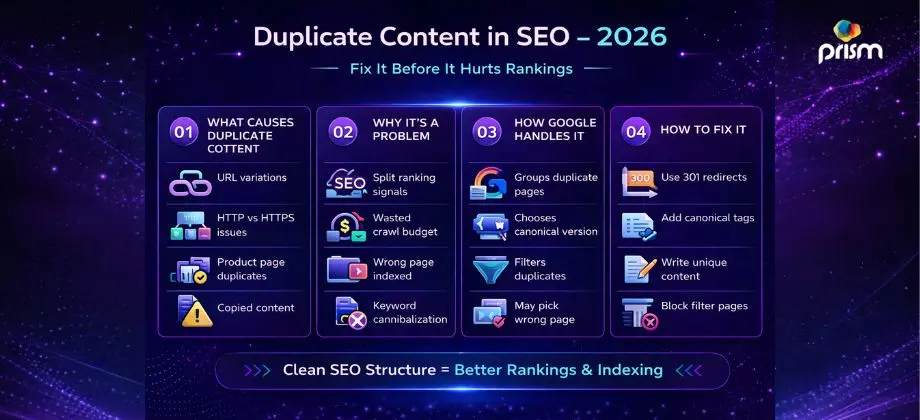
They believe duplicate content is when their article was stolen and posted on another site. But that is not the most common cause. The real culprits are:

URL Variations
Click tracking parameters, analytics codes, and session IDs all create new URLs pointing to the same content. A visitor lands on your product page and gets assigned a unique session ID — suddenly Google sees two pages with identical content under different URLs. Printer-friendly versions of pages do the same thing. They just silently accumulate until your crawl budget is being poured down the drain on dozens of almost identical pages with no value add.
HTTP vs HTTPS / www vs non-www
If your site http://example.com and https://example.com or www.example.com and example.com, then you might have up to four copies of your website available to users. When left unresolved, search engines treat each as a different site and your rank signals and authority are divided among the various versions.
Ecommerce Product Pages — the Biggest Offender in 2026
This deserves more attention than it used to get. SEO duplicate content on product pagesis the number one technical issue Prism Digital encounters when auditing ecommerce websites. A jacket available in five sizes and three colors can generate fifteen near-identical product pages. A category page with sorting and filter options can create hundreds of unique URLs with essentially the same content. Manufacturer descriptions copied across multiple stores compound the problem further. When your crawl budget is eaten up by these pages, genuinely important pages don’t get indexed.
Scraped or Copied Content
When a scraper republishes your content on their site, that is intentional duplication on their part. Less obvious is when multiple ecommerce retailers sell the same product using the manufacturer’s description — technically unintentional, but the SEO effect is the same. Google’s September 2025 Spam Update specifically targeted repetitive content designed to manipulate rankings, making it more important than ever to use original descriptions even when selling identical products.
2026's Top 5 Questions about Duplicate Content
Q1: Does duplicate content actually hurt my Google ranking?
The most debated question in SEO. The honest answer is nuanced. Google does not issue a formalduplicate content penalty— you will not find a manual action in your Search Console for it. Google’s John Mueller has confirmed this repeatedly. However “no direct penalty” doesn’t mean “no consequence.”
What actually happens: Google groups URLs into clusters, selects one representative version to rank, and filters out the rest. If Google chooses the wrong version, or if your backlinks are divided across several versions, your rankings take an indirect hit. And if you have a massive amount of duplicate pages, your crawl budget is wasted on redundant URLs while vital pages sit waiting to be indexed. That crawl budget problem is where duplicate content penaltyeffects really bite — especially on large ecommerce sites.
Q2: Why is having duplicate content an issue for SEO if Google can handle it?
Why is having duplicate content an issue for SEOeven when Google says it can handle it? Since “Google can handle it” means that Google will decide for you — and that decision might not be aligned with what you want. When duplicate pages battle each other, backlinks are also split across multiple URLs instead of going to your best page. Your own pages fight each other for rankings on the same keywords. And the user experience suffers: customers who encounter nearly identical pages during navigation lose trust. None of that is a penalty. All of it damages your site’s performance.
Q3: How does Google duplicate content affect my site differently in 2026?
Google duplicate content handling has become more sophisticated with each algorithm update. The September 2025 Spam Update introduced stricter evaluation of repetitive content created for ranking manipulation purposes — particularly targeting local SEO pages with near-identical content across multiple city or location pages. AI-generated content that produces similar outputs across pages is also now being flagged more aggressively. If you write product descriptions at scale using AI tools, variation is no longer optional.
Q4: What’s the best duplicate content checker for me?
To detect internal duplication, an SEO duplicate content checker such as Screaming Frog, or Ahrefs Site Audit crawls your website and identifies the duplicate, or near duplicate pages. Google Search Console’s Coverage Report shows categories like “Duplicate, Google chose a different canonical than the user” — this is where you find out if Google is overriding your preferences. For external duplication (verify if your content has been copied), Copyscape and Siteliner are the standard tools.
• Google Search Console Coverage Report: Free, Displays the indexing decisions Google is making about your URLs
• Screaming Frog: Scans your site and finds duplicate titles, Meta descriptions and content
• Ahrefs Site Audit: Multifaceted duplicate content detection with issue prioritization
- Copyscape: Checks if your content has been copied to external domains
- Siteliner: Free tool for identifying duplicate content within your own domain
Q5: How does duplicate content specifically affect ecommerce websites?
Ecommerce is where duplicate content does its most damage. A large online store with product variations, filter pages, and sorting URLs can easily generate thousands of duplicate pages without any intentional duplication. The consequences: Google’s crawler spends its budget on redundant filter URLs instead of your new products; product pages fail to get indexed; ranking signals split across URL variations instead of consolidating. Duplicate content on SEO product pagesis not a theoretical concern — it is the reason many ecommerce sites plateau despite producing good content.
How Google’s Algorithm Deals with Duplicate Content
Google’s deduplication process works in two stages. First, it groups all duplicate URLs into a cluster. Then, it selects one URL as the canonical — the representative version to rank. The choice depends on signals like which URL has the most internal links directed to it, or which is in your sitemap.
The key insight here is that Google will canonicalize with or without your input. If you do not tell Google which version you prefer, it will make that decision independently — and the result might not be what you intended. This is why technical SEO matters: 301 redirects, canonical tags, and sitemap consistency are all “hints” that steer Google toward your preferred URL. The more consistent your signals, the more control you retain over which version gets the authority.
Problems Caused by Duplicate Content
For Search Engines
- Confusion about which version to include in the index
- Uncertainty about whether link equity should be consolidated or split
- Wasted crawl budget on redundant pages, leaving important pages uncrawled
For Site Owners
- Diluted visibility — multiple versions compete instead of one strong page ranking
- Split backlinks — your domain authority is divided across duplicate URLs rather than consolidated
- Reduced indexation — Google may refuse to index pages it sees as duplicates of existing content
Content marketing impact: Your investment in quality content marketing services Dubai businesses rely on gets undermined when original content is diluted by duplicate versions
How to Fix Duplicate Content Issues
1. 301 Redirects
If you merge multiple versions of a page permanently, 301 redirects are your answer. Pick a canonical URL and then redirect all the other to that and all traffic and link juice will flow to the winning page. This is the right fix for HTTP/HTTPS conflicts, www vs non-www issues, and retired duplicate pages.
2. Rel=Canonical Tags
When you cannot redirect (for example, if you need multiple URLs to remain technically accessible for functional reasons), the canonical tag tells Google which version you consider the primary one. Use it on ecommerce product variation pages, paginated content, and filter URLs. This is the primary tool for managing Google duplicate contenton ecommerce sites at scale.
3. Unique Product Descriptions
Stop copying manufacturer descriptions. Even if the idea of writing unique copy for each and every product seems like a massive undertaking, that time will be well spent once you factor in the SEO benefits of uniqueness. At least, rewrite the first paragraph of each product description so that every page has something different from the others.
4. Robots.txt and Noindex for Filter Pages
For ecommerce filter and sorting URLs that generate near-identical content, use either robots.txt disallow (to prevent crawling) or a noindex Meta tag (to prevent indexing) to keep these pages out of Google’s index. Be careful not to block pages that carry genuine unique value — only the truly redundant filter combinations.
The Bottom Line
Does duplicate content hurt SEO?Not with a formal penalty. But it wastes your crawl budget, splits your authority, dilutes your rankings, and in a competitive search landscape, efficiency matters. Every duplicate page your site creates is a page that is not helping you rank.
The good news is that most duplicate content issues are entirely fixable with the right technical approach. If you are running an ecommerce store, managing a multi-location business, or simply unsure whether duplicate content SEO impactis affecting your site, a proper audit will surface everything that needs attention. The best SEO Agency in Dubai should be doing this as part of every client engagement — not as an add-on. Whether you work with the SEO companies in Dubai or manage it in-house, the principle is the same: give Google the clearest possible version of your website, tell it exactly which pages you want indexed, and stop leaving deduplication decisions to chance. The best SEO companies do not leave this to guesswork — and neither should you.

About The Author: Lovetto Nazareth
Lovetto Nazareth is the Founder & CEO of Prism Digital, a Dubai-based digital marketing and advertising agency he started nearly two decades ago from a laptop and a vision, as he puts it, to one of the region's established full-service agencies spanning SEO, PPC, social media, web design, and PR.
Over more than 19 years in advertising and digital marketing, Lovetto has guided thousands of campaigns across the UAE and GCC, working across sectors from real estate to hospitality to fintech. He writes and speaks on digital transformation and marketing strategy, and has contributed opinion pieces to Campaign Middle East, one of the region's leading marketing trade publications.
He takes a data-first approach to growth testing, measuring, and iterating rather than relying on guesswork and outside of work he's an adventure sports enthusiast and a singer-songwriter.