
Keyword Research in 2026: The Only Guide You’ll Need to Finding Keywords That Rank
Dive Into Our Podcast
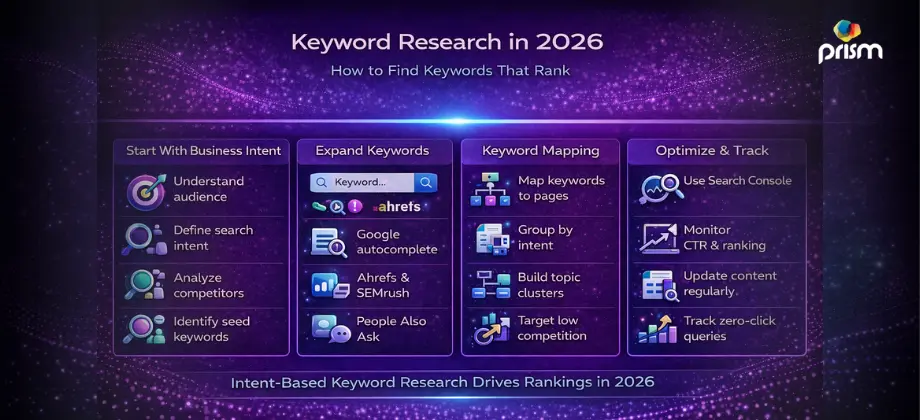
Step 1: Understand the Business Before You Open a Single Tool
This is the step that separates average keyword research in SEOfrom research that genuinely moves the needle. The best keyword list in the world is useless if it’s built for the wrong audience or misaligned with what the business actually sells.
Before starting, ask for a brief. Read the About Us page. Know the product, the audience, and the commercial intent of the site. When you're working with a client, dump all the information you've been given into an AI tool like Claude or ChatGPT to get your insights consolidated quickly — then you can double check them against actual conversations on Reddit, review sites, forums where your audience is talking without any sort of pasteurized containment.
The practical tip: enter a relevant subreddit URL into Ahrefs Site Explorer and look at which organic keywords those threads rank for. You’re not guessing at what the audience cares about — you’re reading direct evidence of it, complete with up-vote counts that validate demand.
Step 2: Find Seed Keywords — Your Starting Point, Not Your Endpoint
Seed keywords are the core words or concepts that represent your business. Think of them as anchors, not answers. “Cup,” “digital marketing,” “property investment” — these are starting points that you will expand in the next step.
Choose seed keywords based on your understanding of the business from Step 1. The more accurately you understand the product and audience, the more targeted your seed keywords will be — and the more relevant everything downstream will become.
A quick trick that still works remarkably well in 2026: YouTube autocomplete and Google autocomplete surface the natural language your audience actually uses in search bars, not the polished language you find in marketing materials.These are free, immediate, and often surface long-tail variations that paid tools miss entirely.
Step 3: Expand Keywords — And Validate Search Intent Manually
Once you have seed keywords, expand them using a combination of:
- SEMrush’s Keyword Magic Tool: Type your seed keyword, then set the difficulty filter to under 30 to begin, and take advantage of the Keyword Gap tool to find out what keywords your competitors are ranking for that you are not.
- Ahrefs Keywords Explorer: Select ‘Matching terms’ for your seed keyword, apply difficulty and volume filters, and review the Parent Topic column to understand thematic clusters rather than isolated keywords.
- Google Keyword Planner: Particularly useful for understanding commercial value via CPC data — high CPC keywords in your niche signal that businesses pay to appear for them, which means they convert.
AnswerThePublic and People Also Ask: Invaluable for question-based keywords. They are gold for FAQ sections, featured snippet possibilities and AEO (Answer Engine Optimisation) for 2026.
But here is the step that most people skip: manually search your keywords on Google before you commit to them. Look at the search results. Are the ranking pages ecommerce product pages, blog posts, or local listings? If you are writing a blog and Google is surfacing product pages for that keyword, your intent is misaligned and you will not rank regardless of content quality.
“Knowing which keywords to target ensures you create content that actually meets demand instead of just guessing what might be helpful.” — SEMrush
One 2026-specific addition: use SEMrush’s AI Visibility Toolkit to check which AI prompts your competitors appear for in ChatGPT and Perplexity that you do not. These are not traditional keywords — they are conversational queries that AI tools process. Appearing in these answers is a growing source of referral traffic that most businesses are not yet optimising for.
Step 4: Keyword Mapping — Where Research Becomes Strategy
This is the step where most keyword research breaks down. Teams produce a list of 200 keywords and then publish content based on instinct rather than search data.Keyword mapping fixes this by assigning specific keywords to specific pages before any content is created.
The practical framework:
• Long-tail keywords first: These give faster wins, set up domain authority, and make sure the strategy is working as you head toward more difficult goals. Long-tail keywords (Keywords containing 3 or more words and having more specific intent) convert at 2.5x the rate of short-tail keywords and they also generate 91.8% of traffic.
• Simultaneously high-difficulty keywords: These are typically the core commercial keywords of the business — the ones that are really worth competing for. Work up to them in topic clusters: a robust pillar page with several related lower-difficulty content pieces all link-ing and passing authority up.
• Group keywords by intent not topic: To informational keywords (e.g. “how to”), to commercial keywords (e.g. “best,” “top”), and transactional key phrases (e.g., “hire,” “buy”) need different types of content. Having these all on the same page is confusing for both the reader and the algorithm.
• Create a map for AI search, as well: Determine question-based queries that offer AI Overviews or featured snippets in the SERPs. Organize your content with direct, succinct answers in the first 100–150 words in order to vie for these positions.
Step 5: Ongoing Optimisation — Because Keywords Are Not a One-Time Project
Keyword research is not something you do once and then file away. Search behavior evolves, competitors adapt, algorithm updates impact on what ranks. Whitehat SEO suggests evaluating your keyword strategy every quarter for most companies on monthly basis for fast-paced industries or during major product launches. Perform well in Google Search Console. Identify keywords on which you rank on page two (positions 11–20) these are your quickest wins because a content refresh, better internal linking, or even one quality backlink can push them to page one. Find those keywords you receive a lot of impressions for but with a low CTR – this suggests you have an issue with the title/meta description, not with your rankings.
And keep your eye on zero-volume keywords. Research shows that some of the most valuable B2B queries — like “HubSpot onboarding agency Dubai” — may show no recorded search volume but represent high-intent buyers ready to act.Volume tells you what is popular. Intent tells you what converts.
The Tools That Power Smart Keyword Research in 2026
Choosing keywords for SEOrequires the right tools. Here’s what serious practitioners are using:
- Ahrefs: Deeper historical SERP data and the best toolset for analysing competitor backlinks and content performance. Essential for gap analysis.
- SEMrush: The strongest competitor analysis suite. Shows exactly which keywords your rivals rank for, URL by URL. The Keyword Magic Tool and AI Visibility Toolkit are the standout features for 2026.
- Google Search Console: Free and irreplaceable. The only tool that shows you actual impressions and click data for your own site from Google.
- AnswerThePublic + Google Trends: For identifying emerging questions and seasonal shifts before they peak. Particularly useful for content calendar planning.
- KWFinder (Mangools): The preferred tool for finding low-competition keywords in 2026, especially for smaller businesses targeting niche local queries.
- Reddit + Ahrefs Site Explorer: Enter a relevant subreddit URL into Ahrefs to see which keywords those community threads rank for organically. This surfaces natural audience language that no paid tool generates on its own.
The honest answer: no single tool does everything. The most effective tools for keyword research are used in combination — Ahrefs for deep competitor analysis, SEMrush for keyword discovery and gap analysis, Search Console for performance monitoring, and Reddit for intent and language validation.
Why Keyword Research Is the Foundation of Everything Else
Bad keyword research is not just a missed opportunity. It is the reason your content budget generates traffic that never converts, rankings that plateau, and blogs that no one reads. Every piece of content, every landing page, and every product page needs to start with this process done properly.
B2B companies using strategic keyword research achieve 748–1,389% ROI from SEO over three years compared to 16% ROI for businesses publishing content without proper keyword strategy.The gap is not in the tools. It is in the process, the expertise, and the willingness to understand the business before the research begins.
If you want keyword research in SEOdone the right way — with a proper understanding of your market, audience, and commercial goals — the place to start is with an SEO Companythat treats research as strategy, not just a checklist. That is the difference between content that compounds and content that sits.

About The Author: Lovetto Nazareth
Lovetto Nazareth is the Founder & CEO of Prism Digital, a Dubai-based digital marketing and advertising agency he started nearly two decades ago from a laptop and a vision, as he puts it, to one of the region's established full-service agencies spanning SEO, PPC, social media, web design, and PR.
Over more than 19 years in advertising and digital marketing, Lovetto has guided thousands of campaigns across the UAE and GCC, working across sectors from real estate to hospitality to fintech. He writes and speaks on digital transformation and marketing strategy, and has contributed opinion pieces to Campaign Middle East, one of the region's leading marketing trade publications.
He takes a data-first approach to growth testing, measuring, and iterating rather than relying on guesswork and outside of work he's an adventure sports enthusiast and a singer-songwriter.