
Top Performance Max optimization tips for 2026
Dive Into Our Podcast
Why Landing Page Images Matter More in Performance Max
The traditional approach of Google Ads campaigns grants advertisers complete authority over their advertising materials. Marketers design banners by hand and upload them to designated advertising locations.
Performance Max works differently.
Instead of relying only on manually designed creatives, Google’s machine learning system automatically generates ad combinations across multiple channels, including:
- Search
- Display
- Discover
- Gmail
- YouTube
To build these ads, Google uses available assets such as:
- headlines
- descriptions
- videos
- product feeds
- images
And importantly, when image assets are limited—or when Google believes it can improve performance—the system may extract images directly from the landing page.
In many PMax campaigns I’ve reviewed, weak ad creatives weren’t actually caused by the algorithm. They were caused by poor landing page images that the algorithm used as inputs.
This is why marketers should think of landing page visuals not just as design elements, but as creative assets for automated advertising systems.
How Google’s AI Uses Landing Page Images
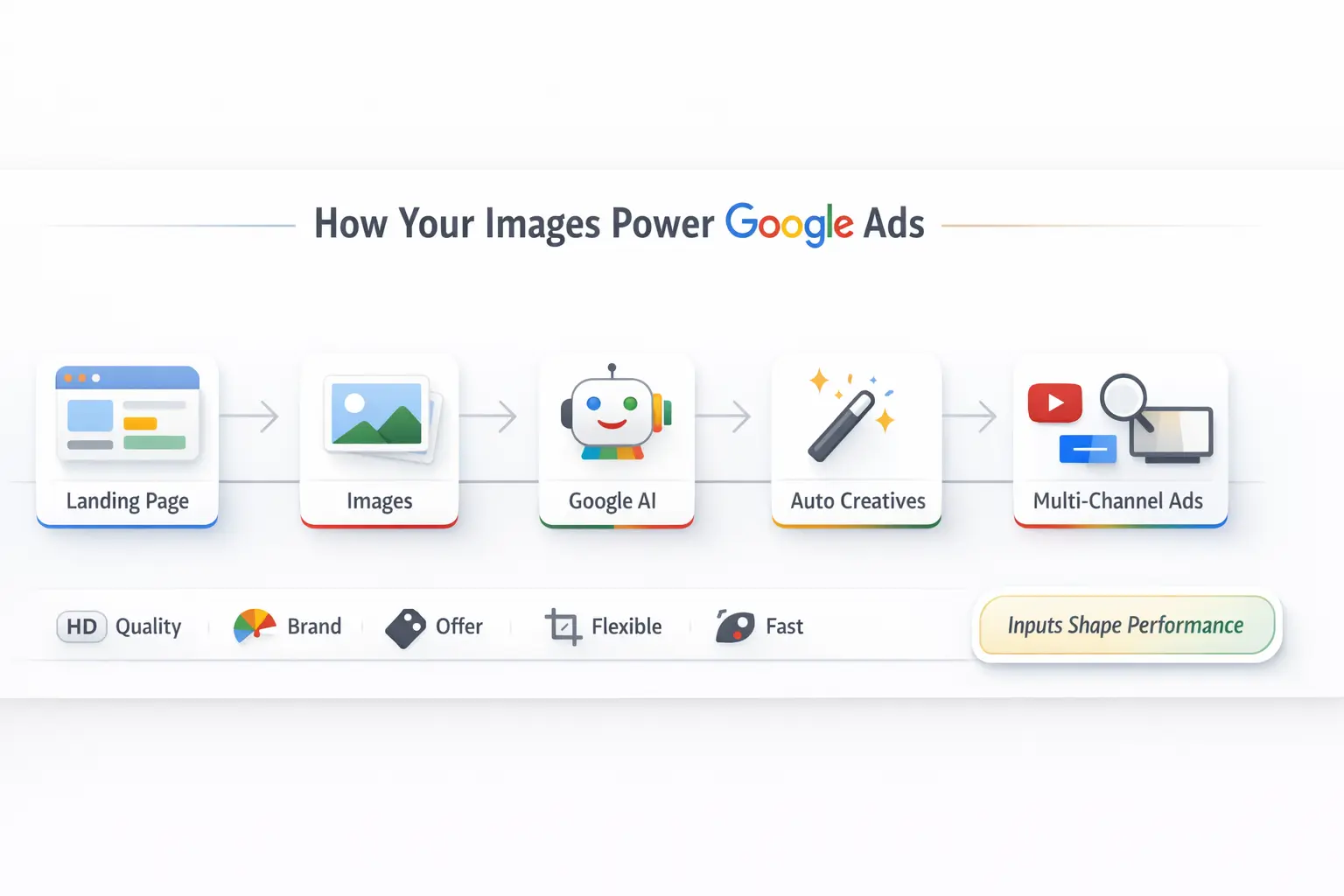
Google’s advertising systems are designed to assemble ad variations dynamically.
To do this, the platform may:
- extract images from landing pages
- auto-generate display banners
- crop images to fit different placements
- combine multiple visuals into collage-style creatives
These automatically generated ads then appear across Google’s network depending on where the algorithm predicts the best performance.
The challenge is that the AI doesn’t always choose images the same way a designer would.
Images may be cropped into square, landscape, or vertical formats. Sometimes Google may combine multiple images into a single visual asset for display placements.
This means marketers must ensure that landing page images are clear, simple, and visually adaptable.
The algorithm will have difficulty processing a product image which exists only in one particular layout.
Best Practices for Choosing Landing Page Images
Use High-Quality Professional Images
This requires use of High-Quality Professional Images as their standard. The image quality determines how Google displays advertisements throughout its advertising network. Automated ads appear unprofessional when they use images from poorly lit product shots or blurry photos or cluttered compositions. Google AI requires high-quality visuals which show strong contrast and distinct subject matter for its creative work. In performance marketing, this matters more than many advertisers realize. If your images are weak, the algorithm can’t magically create great ads from them.
Maintain Consistent Brand Visuals
The need to have visual elements of the brand stay identical across all instances. The visual design of a brand needs to maintain uniformity throughout all people. When companies establish identical visual elements on their landing pages, which use matching lighting and color schemes and background designs, they create a unified brand identity that enables customers to identify their company.
For example, the consistent visuals create a more cohesive experience when Google generates ad variations across:
- product imagery
- lifestyle photos
- backgrounds
- brand colors
This consistency improves both ad engagement and brand trust.
Highlight the Offer Clearly
Images should communicate value immediately.
In performance marketing, attention spans are short. Whether an ad appears on YouTube, Discover, or Display, users make split-second decisions about whether to engage.
Strong landing page visuals often include:
- product imagery
- real-life usage scenarios
- problem–solution visuals
In my opinion, the best marketing images aren’t always the most artistic—they’re the ones that communicate value instantly.
Image Strategies That Improve Ad Performance
Lifestyle Imagery
Lifestyle images showing people interacting with products or services often perform better than isolated product shots.
These visuals help users imagine themselves using the product.
For campaigns targeting UAE audiences, contextual imagery can also help. Examples might include:
- modern office environments
- multicultural professional teams
- retail or hospitality settings common in the region
Images that feel culturally relevant can increase engagement.
Strategic Image Placement on Landing Pages
Where images appear on a landing page also matters.
Key visuals should be positioned near important messaging elements, including:
- the hero headline
- call-to-action buttons
- product benefit sections
- testimonials
This placement helps reinforce the value proposition and ensures the algorithm can easily extract meaningful visuals.
Provide Multiple Image Formats
Since Performance Max distributes ads across multiple channels, images must work in different aspect ratios.
Providing a mix of formats improves flexibility for automated placements.
Recommended formats include:
- square images
- landscape images
- vertical images
This allows Google to adapt creatives more effectively across Display, Discover, and YouTube placements.
Technical Image Optimization for Faster Pages
Landing page images also influence page speed, which directly impacts user experience and conversion rates.
Large image files can slow down page loading times, increasing bounce rates and reducing campaign effectiveness.
Best practices include:
- using modern formats such as WebP
- compressing images before uploading
- keeping file sizes under 100–200 KB
- minimizing unnecessary image elements
Faster landing pages improve both user experience and ad performance.
When Performance Max drives traffic to slow pages, even great ad creatives won’t fully compensate for poor page speed.
Tools for Optimizing Landing Page Images
Marketers use a variety of different tools to compress images and still maintain the original quality. The most frequently used tools are :
TinyPNG – a tool that compresses PNG and JPEG files by a significant size while maintaining visual quality.
Squoosh – a web app created by Google that provides more advanced compression and format conversion options.
ImageOptim – popular tool used to compress images on Mac.
ShortPixel – WordPress plugin that compresses and converts your images automatically to make your site load faster.
These products allow marketers to compress image sizes, without compromising the visual sharpness of the image.
AI Tools for Generating Landing Page Visuals
Another major shift in marketing is the rise of AI-powered creative tools.
Platforms such as:
- Midjourney
- DALL-E
- Adobe Firefly
- Canva AI
enables marketers to create professional visual content. The tools enable users to produce product pictures and lifestyle images and advertising materials without the need for costly photo sessions. Marketers can produce multiple distinct image variations which they can use to reach different target audiences and create specific advertising campaigns. AI technology enables users to create advertisement-ready images within minutes which used to need professional photographers and designers together with large financial resources. The system enables Performance Max campaigns to test their creative content through its flexible testing options.
Practical Insight From Performance Max Practitioners
Discussions within PPC communities often highlight an interesting issue: Google sometimes generates collage-style display ads using images pulled from landing pages.
The algorithm creates one ad creative from multiple visual elements when this specific situation occurs.
The ad will appear disorganized and difficult to understand when your landing page images are displayed in poor quality and uneven design.
This is why marketers should treat landing page images as ad-ready creative assets.
Images should be:
- brand-safe
- visually clear
- adaptable to cropping
- suitable for automated placements
Thinking this way helps prevent unexpected creative outcomes.
Conclusion
Performance Max campaigns are often described as automated advertising systems where marketers have limited control.
But one important truth remains: the quality of the inputs shapes the quality of the outputs.
Landing page images are not just decorative design elements. They are part of the creative material that Google’s AI may use to generate ad visuals across its advertising network.
If your landing page images are poorly designed, the algorithm has weak material to work with.
If your visuals are strong, consistent, and strategically structured, you give the AI a better foundation for generating effective ads.
From my perspective, marketers who understand this dynamic gain a real advantage.
Because in the world of automated advertising, the smartest strategy isn’t just optimizing campaigns.
It’s optimizing the inputs that train the algorithm.
Landing page images are one of those inputs—and they deserve far more strategic attention than most advertisers currently give them.

About The Author: Lovetto Nazareth
Lovetto Nazareth is the Founder & CEO of Prism Digital, a Dubai-based digital marketing and advertising agency he started nearly two decades ago from a laptop and a vision, as he puts it, to one of the region's established full-service agencies spanning SEO, PPC, social media, web design, and PR.
Over more than 19 years in advertising and digital marketing, Lovetto has guided thousands of campaigns across the UAE and GCC, working across sectors from real estate to hospitality to fintech. He writes and speaks on digital transformation and marketing strategy, and has contributed opinion pieces to Campaign Middle East, one of the region's leading marketing trade publications.
He takes a data-first approach to growth testing, measuring, and iterating rather than relying on guesswork and outside of work he's an adventure sports enthusiast and a singer-songwriter.