
How to Measure Digital Marketing ROI and Lead Quality in the UAE
The short answer: which KPIs matter?
If you only track five digital marketing KPIs, make them qualified leads, cost per qualified lead, and conversion rate from lead to customer, customer acquisition cost and return on investment. Impressions, reach and click-through rate are useful for diagnosing campaigns, but they can't tell you whether marketing paid for itself.
ROI, ROAS, CPL and CAC: what each metric means
Simple formulas with worked examples
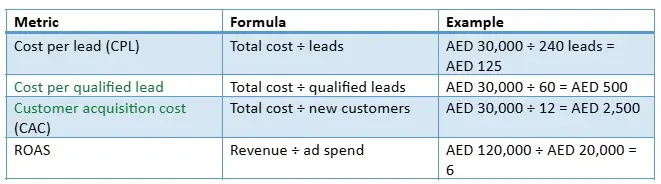
Say a Dubai services firm spends AED 30,000 in a month: AED 20,000 on ads, AED 8,000 in agency fees and AED 2,000 on creative.
The ROI line assumes a 40% gross margin on AED 120,000 of revenue. Notice how different the story looks. A ROAS of 6 sounds spectacular; a 60% ROI is healthy but far less dramatic. That gap is the heart of the ROAS vs ROI confusion. ROAS ignores fees, creative and margin. ROI doesn't.
How do I calculate digital marketing ROI?
Subtract total marketing cost from the gross profit it generated, then divide by the total cost. Use gross profit rather than revenue wherever you can.
Define a qualified lead before reporting
MQL vs SQL vs opportunity vs customer
These stages only work if marketing and sales agree on them in writing:
- A marketing qualified lead (MQL) fits your target profile, for example the right emirate, budget range and service.
- A sales qualified lead (SQL) has spoken to sales and confirmed a real need and timeline.
- An opportunity has a proposal or quote out.
- A customer has paid.
How do I measure qualified leads instead of form fills?
Add a status field in your CRM, ask sales to update it within 48 hours of first contact, and report on SQLs and opportunities by source. Useful lead quality metrics include lead-to-SQL rate, SQL-to-customer rate and average deal value by channel.
Set up reliable tracking
GA4 events, Google Ads conversions, UTMs and CRM source fields
Mark form submissions, calls and WhatsApp clicks as key events in GA4. Import them into Google Ads, or use Google Ads' own conversion tags. Add UTM tags to every social, email and partner link so the source survives into your analytics. Then pass the source into a CRM field when the lead is created, so you can follow it all the way to a sale.
How can I track leads from Google Ads and social media?
UTMs plus a hidden form field that captures them, stored in your CRM against each lead. A properly set-up Zoho CRM handles this well.
Phone calls, WhatsApp enquiries and offline conversions
This is where UAE tracking usually breaks, because so many enquiries arrive on WhatsApp or by phone. Use call tracking numbers per channel, track WhatsApp button clicks as events, and consider the WhatsApp Business API so conversations can be logged in the CRM. Upload closed deals back into Google Ads as offline conversions so bidding learns from real customers, not just form fills.
Build a UAE marketing dashboard
Channel, campaign, audience and landing-page views
One page, refreshed weekly: spend, leads, qualified leads, cost per qualified lead and revenue by channel, then the same by campaign and landing page. Keep definitions identical month to month, or your digital marketing ROItrend stops meaning anything. Our article on why Looker Studio reports often misleadcovers the common traps.
Attribution: what it can and cannot tell you
Marketing attribution assigns credit for a conversion across the touchpoints that led to it. GA4 and Google Ads now default to data-driven attribution, since Google retired first-click, linear, time-decay and position-based models in 2023. Attribution is helpful for comparing channels, but it can't see conversations offline, word of mouth or a WhatsApp forward between colleagues. Treat it as a guide and test big decisions with controlled budget changes. We explain this further in AI-based attribution explained.
A monthly review checklist
1. Check tracking still fires on every form, call and WhatsApp button.
2. Reconcile lead counts between ad platforms, GA4 and the CRM.
3. Review lead status with sales.
4. Calculate cost per qualified lead and CAC by channel.
5. Compare ROI with last month and the same month last year, allowing for Ramadan and summer.
6. Move budget towards channels producing qualified pipeline.
Common reporting mistakes
The ones that cost the most: counting every form fill as a lead, comparing ROAS to ROI as if they were the same, changing attribution settings mid-year, and ignoring leads that arrived by phone. Another is never closing the loop with sales, so marketing keeps optimizing for volume.
FAQs
How do you calculate digital marketing ROI?
ROI equals gross profit from marketing minus total marketing cost, divided by total cost. Include ad spend, fees, creative and tools.
What is the difference between ROI and ROAS?
ROAS compares revenue with ad spend only. ROI compares profit with all marketing costs, so it's the better measure of whether marketing made money.
What is a good cost per lead in the UAE?
There's no reliable UAE-wide benchmark. Work backwards from customer value and close rate to find the most you can afford.
How should WhatsApp leads be tracked?
Track WhatsApp clicks as events, use separate numbers or pre-filled messages per channel, and log every conversation in your CRM.
How often should marketing performance be reviewed?
Leads weekly, ROI monthly and channel strategy quarterly. If you'd like help to measure marketing ROI UAEteams can trust, our paid media and lead generationteams can review your tracking, or contact usfor a conversation about improving your digital marketing ROI.

About The Author: Lovetto Nazareth
Lovetto Nazareth is the Founder & CEO of Prism Digital, a Dubai-based digital marketing and advertising agency he started nearly two decades ago from a laptop and a vision, as he puts it, to one of the region's established full-service agencies spanning SEO, PPC, social media, web design, and PR.
Over more than 19 years in advertising and digital marketing, Lovetto has guided thousands of campaigns across the UAE and GCC, working across sectors from real estate to hospitality to fintech. He writes and speaks on digital transformation and marketing strategy, and has contributed opinion pieces to Campaign Middle East, one of the region's leading marketing trade publications.
He takes a data-first approach to growth testing, measuring, and iterating rather than relying on guesswork and outside of work he's an adventure sports enthusiast and a singer-songwriter.